

USLAW launches Legaltech Hub In-House Legal Team Referral Program
USLAW NETWORK is extending its collaboration with Legaltech Hub - the leading platform for legal technology insights,… Continue Reading






USLAW NETWORK is extending its collaboration with Legaltech Hub - the leading platform for legal technology insights,… Continue Reading

Twelve exceptional law students from ABA-accredited law schools across the United States have been named recipients of… Continue Reading

USLAW was founded in 2001 and has focused on delivering exceptional client service, trusted relationships and friendships… Continue Reading

USLAW NETWORK provides legal decision-makers with access to attorneys who are highly knowledgeable and skilled in jurisdictions… Continue Reading

USLAW NETWORK is supported by our family of corporate partners, each of whom provides a high-level expertise… Continue Reading

USLAW NETWORK is a terrific business development, networking, and professional development organization for lawyers across a spectrum… Continue Reading

USLAW’s Mediators and Arbitrators Practice Group includes experienced litigators who serve as designated neutrals to help clients… Continue Reading

The USLAW NETWORK Complex Tort and Product Liability Practice Group is a nationwide network of experienced attorneys… Continue Reading
USLAW NETWORK is extending its collaboration with Legaltech Hub - the leading platform for legal technology insights,… Continue Reading

The Summer 2026 edition of USLAW Magazine is now available to read, bookmark and download. Published exclusively… Continue Reading
USLAW NETWORK was founded with the intention of revolutionizing the legal industry and establishing a platform for… Continue Reading
Twelve exceptional law students from ABA-accredited law schools across the United States have been named recipients of… Continue Reading
POSTED MAY 15, 2026
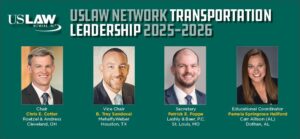
The U.S. Supreme Court issued its landmark decision in Montgomery v. Caribe Transport II, LLC. USLAW NETWORK’s Transportation and Logistics Practice Group Leadership Team examines the ruling and its implications for the transportation industry, with a focus on shipping and freight brokers.
In Montgomery v. Caribe Transport II, LLC, No. 24-1238 (U.S. May 14, 2026), the Supreme Court delivered a decision that transportation brokers and their insurers have been dreading—that negligent selection claims against brokers are not preempted by federal law. In a 9-0 decision, the Supreme Court held that the Federal Aviation Administration Authorization Act’s (“FAAAA”) safety exception [49 U.S.C. § 14501(c)(2)(A)] preserves state law negligent selection claims against brokers, and thus FAAAA’s broad preemption provision, which had long served as a shield for brokers, will no longer block state law claims alleging that a broker selected a carrier it knew was unsafe. The decision is immediately applicable to current and future lawsuits.
Justice Barrett, writing the majority opinion, framed the analysis in terms of giving the subject statutory language its “ordinary meaning.” To this end, Justice Barrett explained that the FAAAA’s safety exception preserves “the safety regulatory authority of a State with respect to motor vehicles”— and state law negligence claims asserting that a broker selected a motor carrier with a known substandard safety record plainly “concerns” motor vehicles within the safety exception’s reach. The Court brushed aside warnings that this interpretation would effectively swallow up the preemption provision, explaining that state laws directed to carrier prices, routes, and services, with no safety nexus, remain firmly preempted. Justice Kavanaugh, concurring with Justice Alito, was notably less resolute in the Court’s position. He acknowledged the case was “closer than the Court’s opinion perhaps might suggest” and offered the candid warning that “state tort law can be unpredictable, and the costs to brokers of litigation and insurance may be significant even when brokers prevail in lawsuits,” with those costs ultimately “cascad[ing] through the economy” to consumers.
What does this mean? For carriers, brokers, and their insurers, the anticipated effect is not only significant but also immediate. With preemption off the table, we can expect brokers to be targeted by the plaintiff’s bar. Brokers will continue to be named in truck accident lawsuits, and likely more so than before, as we know the penchant of the plaintiff’s bar of adding deep-pocket defendants any time they can. Simply put, the threshold defense that had allowed brokers in the Seventh and Eleventh Circuits to quietly exit cases early is no more. And while today’s opinion does not apply to lawsuits pending in state courts, we expect most, if not all, state courts will follow Montgomery.
The decision also means brokers will need to defend these cases on the merits. In discovery, brokers will be expected to produce brokers’ carrier selection files, internal communications, hiring practices, and other vetting procedures. Be prepared for plaintiffs’ counsel to nitpick through each and every memorandum, report, spreadsheet, and email for even the slightest shred of evidence that a broker opted for cost savings over safety.
In light of Montgomery, we recommend brokers immediately evaluate their carrier selection protocols, institute comprehensive carrier vetting protocols, and maintain detailed records memorializing adherence to same, keeping in mind that these protocols will be viewed in light of a state law duty of “reasonable care.” Any documentation gaps will certainly be taken advantage of at trial. Also, as multi-party discovery becomes the rule rather than the exception, be prepared for litigation costs to rise considerably, which will inevitably translate into higher insurance premiums. This trend will likely drive plaintiffs’ settlement demands upward and result in a greater number of cases reaching the trial stage. The overall costs of trucking litigation just went up—and, not just for brokers, but for EVERYONE!