


2025 USLAW NETWORK Foundation Law School Scholarship recipients announced
Twelve accomplished law school students from ABA-accredited law schools across the country have been named recipients of… Continue Reading






Twelve accomplished law school students from ABA-accredited law schools across the country have been named recipients of… Continue Reading
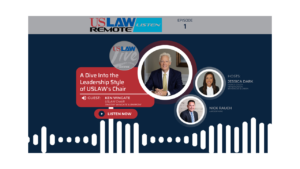
USLAW NETWORK Chair Ken Wingate is the first guest on USLAW Live USLAW NETWORK officially launches USLAW… Continue Reading

USLAW was founded in 2001 and has focused on delivering exceptional client service, trusted relationships and friendships… Continue Reading

USLAW NETWORK provides legal decision-makers with access to attorneys who are highly knowledgeable and skilled in jurisdictions… Continue Reading

USLAW NETWORK is supported by our family of corporate partners, each of whom provides a high-level expertise… Continue Reading

USLAW NETWORK is a terrific business development, networking, and professional development organization for lawyers across a spectrum… Continue Reading

The USLAW Cross-Border Transactions community includes attorneys from United States, Canada, Latin America, Europe and Asia who… Continue Reading

The USLAW NETWORK Complex Tort and Product Liability Practice Group is a nationwide network of experienced attorneys… Continue Reading

Add latest issue of USLAW Magazine to your summer reading list Looking to add to your summer… Continue Reading

State Judicial Profiles by County Jurisdictional awareness of the court and juries on a county-by-county basis is… Continue Reading

From the beginning of our organization, USLAW NETWORK has championed the cause of racial equality. We believe… Continue Reading
Twelve accomplished law school students from ABA-accredited law schools across the country have been named recipients of… Continue Reading
POSTED SEPTEMBER 30, 2025
 Klinedinst PC attorneys Robert Shaughnessy and Gregory Garbacz secured an excellent result and a published appellate decision when defending an attorney and her law office after they were sued by the opposing party in an unlawful detainer action that the attorney was prosecuting for her own client, a mobile-home park. Because the attorney-defendant was sued by a nonclient who alleged causes of action against her based on her representation of another party, California’s anti-SLAPP statute at Code of Civil Procedure section 425.16 applied to bar the nonclient’s meritless claims. (SLAPP is an acronym for Strategic Lawsuit Against Public Participation.) Klinedinst attorneys filed a special motion to strike the complaint under California’s anti-SLAPP law in the Los Angeles Superior Court. After the trial court erroneously denied the motion in a ruling that failed to consider controlling authority, including Thayer v. Kabatek Brown Kellner LLP (2012) 207 Cal.App.4th 141, 158, Klinedinst attorney, Robert M. Shaughnessy, appealed the decision. Under California’s anti-SLAPP law, a moving defendant must show that the claims leveled by the plaintiff arise from protected speech or petitioning activity (Referred to as “prong one” of the anti-SLAPP law). If the moving defendant makes the showing, the plaintiff must present evidence showing the claims have at least minimal merit. (Referred to as “prong two.”) The trial court denied the motion despite the fact that the moving papers established that the claims against the attorney-defendant arose from protected petitioning activity on behalf of her client, and the opposition failed to present any evidence showing that the plaintiff’s claims had even minimal merit.
In a published decision, filed on August 8, 2025, the Second District reversed the trial court with directions to enter an order granting the special motion to strike, and to determine the fees and costs that plaintiffs must pay to the attorney defendant based on the fee provision in California’s anti-SLAPP law. The Second District summed up the issues of the case concisely: “If you are a party in litigation, your tactic of suing opposing counsel is apt to trigger swift retaliation: an anti-SLAPP motion. If opposing counsel are helping their clients petition for legal relief, your motion may fall within anti-SLAPP’s prong one, as an attack on petitioning activity. If so, then prong two will require you to produce evidence our claims have minimal merit. If you cannot show minimal merit, you may have to pay your opponent for the trouble you have caused. This case fits this pattern.” (Opinion, p. 1-2 (emphasis in original).) The published decision will provide needed guidance to trial courts, and to lawyers defending lawyers who are sued for assisting their own clients with petitioning activity in California courts.